Updated on 29.09.2026
Charging a Nissan Leaf in Europe depends first on its generation and market of origin. Earlier models generally use Type 1 or Type 2 for AC charging and CHAdeMO for DC fast charging, while the all-new European Leaf combines Type 2 AC charging with a CCS2 connection.
At EVniculus, we regularly work with Nissan Leaf owners looking for the right cable, charger or adapter for their particular vehicle. The questions they bring us have changed considerably over the years because Nissan Leaf charging is no longer based on a single combination of connectors and charging speeds. The Leaf name now covers three generations, several battery capacities and different regional specifications.
Before choosing any charging equipment, we recommend identifying the exact vehicle rather than relying on its registration year alone. The charging inlet, original market and onboard charger provide a much more reliable answer.
Nissan Leaf Charging by Generation
The following comparison provides a practical starting point for European drivers. Specifications can vary according to country, model year and equipment level, while imported vehicles may use different connectors.
|
Nissan Leaf version |
Typical AC connection in Europe |
DC fast-charging connection |
Typical charging capability |
|
First generation, ZE0/AZE0 |
Type 1 |
CHAdeMO, where fitted |
3.3 or 6.6 kW AC; commonly up to 50 kW DC |
|
Second generation, ZE1 |
Type 2 |
CHAdeMO |
Up to 6.6 kW AC; up to 50 kW for the 40 kWh model and 100 kW for the larger-battery version |
|
All-new European Leaf |
Type 2 |
CCS2 |
11 kW AC; up to 105 kW with the 52 kWh battery or 150 kW with the 75 kWh battery |
Nissan’s 2023 Leaf owner’s manual identifies CHAdeMO as the fast-charging standard for the previous generation. By contrast, the current European specifications list an 11 kW onboard AC charger and CCS charging for the all-new model.
In our experience, the safest rule is also the simplest: check the physical inlet, owner’s manual and vehicle specification before ordering a cable or adapter.
Nissan Leaf Charging Port
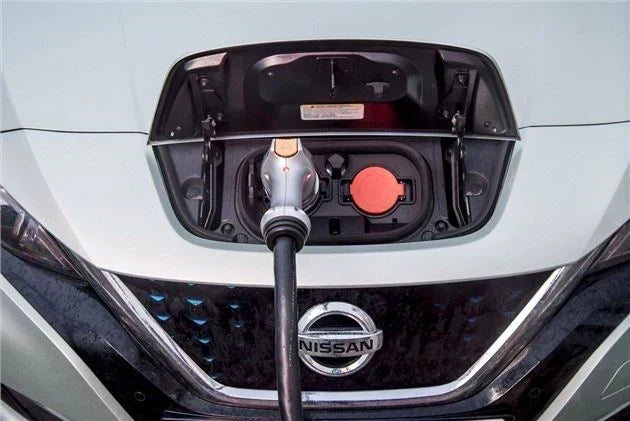
Earlier Nissan Leaf models have their charging connections behind a flap at the front of the vehicle. Depending on the generation and market, this area may contain a Type 1 or Type 2 AC inlet together with a separate CHAdeMO port for DC fast charging.
Many first-generation European Leafs use Type 1 for AC charging. The second-generation European model generally moved to Type 2 while retaining CHAdeMO. The all-new European Leaf represents a larger change because it uses Type 2 for AC charging and CCS2 for rapid DC charging. Its charging inlet is also positioned differently, so the familiar front-centre charging flap should no longer be described as a feature of every Leaf.
CHAdeMO remains highly relevant to the large number of older Leafs still in daily use. Our detailed comparison of CHAdeMO and CCS explains how the two standards communicate with the vehicle and why they cannot be connected directly without an active conversion device.
Why the Market of Origin Matters
The model year does not tell the whole story because Nissan equips vehicles for the charging infrastructure of their intended market. The all-new European Leaf uses Type 2 and CCS2, whereas the current North American version uses J1772 for AC charging and NACS for DC fast charging.
Japanese imports and older North American cars can differ again. When one of our customers owns an imported Leaf, we normally begin by checking a clear photograph of the charging inlet. This simple step often prevents the purchase of an unsuitable cable or adapter.
Nissan Leaf Home Charging
Home charging is normally the most convenient and economical way to keep a Nissan Leaf ready for everyday driving. The appropriate equipment, however, depends on the car’s AC inlet, onboard charger and the available electrical supply.
Can you charge a Nissan Leaf at home?
Yes, a Nissan Leaf can be charged at home from a professionally installed wallbox or, where the electrical installation permits it, from a suitable household socket using an approved portable EVSE.
For regular use, we generally recommend a dedicated wallbox. It provides a stable electrical connection, suitable protection and more convenient control over charging times. Depending on the model, it may also offer scheduling, energy monitoring or integration with off-peak electricity tariffs.
The vehicle will only draw the power its onboard charger can accept. Connecting an older 6.6 kW Leaf to an 11 or 22 kW AC unit will therefore not make the car charge beyond 6.6 kW.
How to charge Nissan Leaf at home?
Begin by confirming whether the car has a Type 1 or Type 2 AC inlet. European second-generation Leafs normally connect to a Type 2 wallbox, while an early Type 1 model needs either a tethered Type 1 charger or a cable with the correct connection at each end.
Once the vehicle is connected, the Leaf and EVSE communicate before electricity begins to flow. Charging can start immediately or follow the schedule configured in the car or charging unit. Our guide to how to charge Nissan Leaf electric vehicles provides a closer look at the basic charging process.
Owners of the all-new European Leaf can make use of its 11 kW onboard AC charger when a compatible three-phase supply and charging unit are available. Older models are usually limited to 3.3 or 6.6 kW and may only draw power from one phase.
Can You Safely Charge a Nissan Leaf from a Household Socket?
A household socket can provide occasional or low-power charging, but it should not be treated like an ordinary appliance connection. An electric car draws a continuous current for many hours, which places considerably more demand on the socket and wiring than most domestic devices.
Nissan advises owners to use a dedicated, properly grounded 220–240 V outlet that complies with local regulations. The manufacturer also warns against using extension leads or additional plug adapters and recommends having older or uncertain electrical installations inspected by a qualified electrician.
At EVniculus, we also advise customers to stop using any socket, plug or charging cable that shows signs of excessive heat, discoloration or physical damage. Charging from a household outlet is considerably slower than using a wallbox and, depending on the battery and available current, a full session can extend well beyond one night.
How to Choose the Right Nissan Leaf Charging Cable
When customers ask us to recommend a Nissan Leaf charging cable, we first establish the connection on the vehicle and the socket available at the charging point. The advertised power of the station is important, but it does not reveal whether the cable will physically connect to the car or how much power the Leaf can accept.
An early Leaf with a Type 1 inlet generally needs a Type 2-to-Type 1 cable when using an untethered European Type 2 charging point. A European ZE1 or all-new Leaf with a Type 2 inlet normally uses a Type 2-to-Type 2 Mode 3 cable. At a tethered station, the charging lead is already attached, so its vehicle connector must fit the car directly or through a suitable approved adapter.
Cable rating also matters. A 32 A single-phase cable can support the maximum AC capability of a 6.6 kW Leaf, while the all-new model needs compatible three-phase equipment to take advantage of its 11 kW onboard charger. Choosing a higher-rated cable may be useful with a future vehicle, but it cannot increase the present car’s charging limit.
We also recommend selecting a length that works with the owner’s usual parking position. The cable should reach comfortably without being stretched, driven over or extended through an improvised connection.
When Do You Need a Nissan Leaf Type 2 Charging Cable?
A Nissan Leaf Type 2 charging cable is needed when the vehicle has a Type 2 inlet and the wallbox or public AC station provides an untethered Type 2 socket. This is the usual arrangement for second-generation European Leafs and the all-new European model.
A first-generation Leaf with a Type 1 inlet does not normally use a Type 2-to-Type 2 cable. At a socketed European station, it needs a Type 2-to-Type 1 cable instead. Drivers also do not need to carry their own cable for most DC fast chargers because CHAdeMO and CCS2 stations provide a permanently attached charging connector.
How Long Does It Take to Charge a Nissan Leaf?
Charging time depends on battery capacity, the car’s onboard charger, the power actually delivered by the station, the starting charge level and battery temperature. The figures below should therefore be treated as practical estimates rather than guaranteed session times.
|
Nissan Leaf version |
Approximate AC charging time |
DC fast charging |
|
First-generation 24–30 kWh Leaf |
Approximately 4–10 hours, depending on the 3.3 or 6.6 kW onboard charger |
Around 30 minutes to 80% under suitable conditions |
|
Second-generation 40 kWh Leaf |
Approximately 7 hours at 6.6 kW |
Up to 50 kW |
|
Second-generation 62 kWh Leaf e+ |
Approximately 10–11 hours at 6.6 kW |
Up to 100 kW |
|
All-new 52 kWh Leaf |
Around 9 hours at 7.4 kW or 6 hours at 11 kW, from 10% to 100% |
Approximately 35 minutes from 10% to 80% at a suitable 105 kW charger |
|
All-new 75 kWh Leaf |
Around 12 hours at 7.4 kW or 7 hours at 11 kW, from 10% to 100% |
Approximately 35 minutes from 10% to 80% at a suitable 150 kW charger |
A charger’s headline rating does not describe the power the car will receive throughout the session. DC charging normally reaches its highest rate within a limited part of the charging curve and then slows as the battery fills.
Which Nissan Leaf Charging Stations Can You Use in Europe?
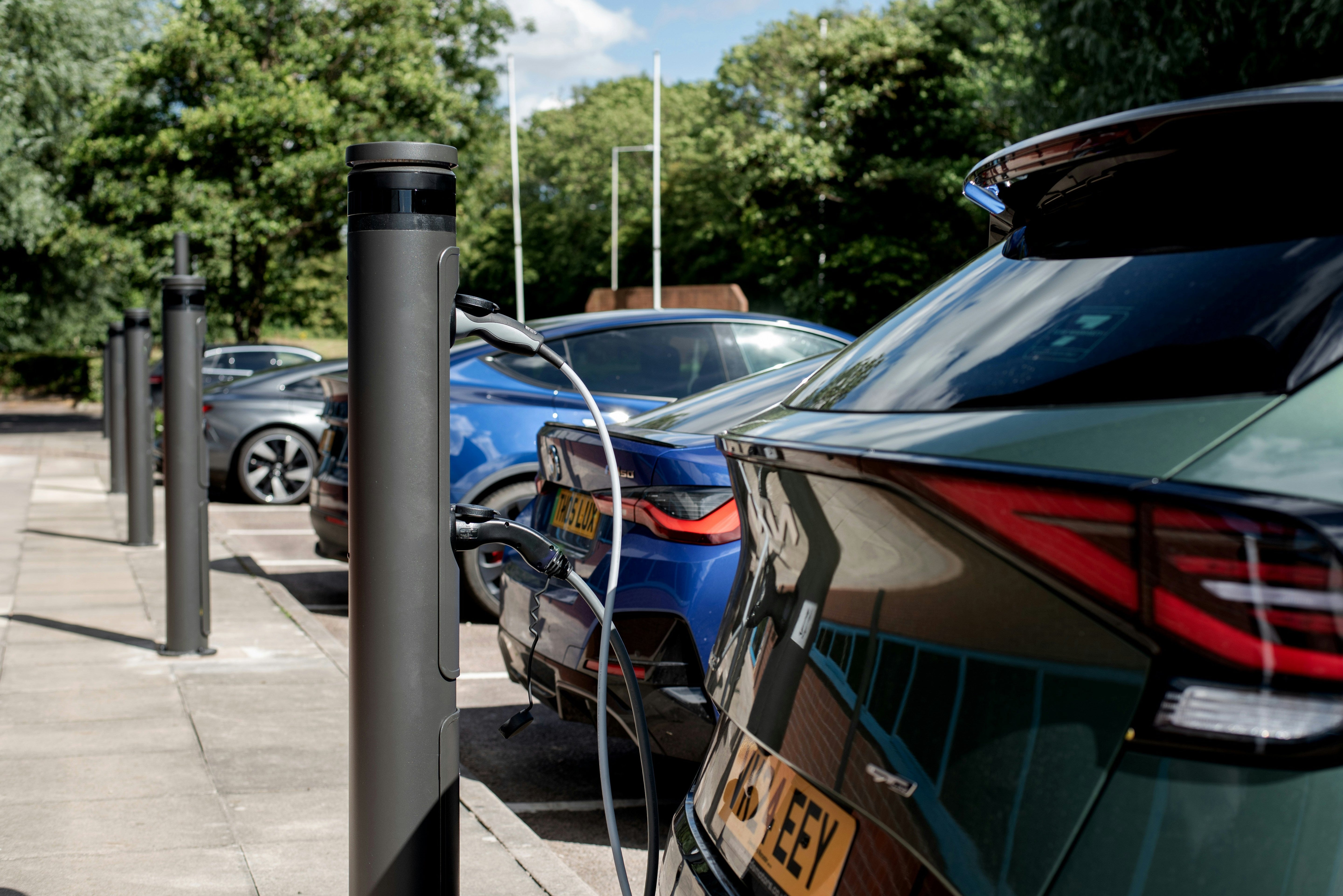
Compatible Nissan Leaf charging stations depend on the car’s AC and DC ports. For AC charging, a European Type 2 station can serve a Type 2 Leaf directly or an older Type 1 Leaf through the appropriate Type 2-to-Type 1 cable. If the station has an attached cable, its vehicle connector must match the car.
For DC charging, first- and second-generation Leafs with a CHAdeMO inlet can use compatible CHAdeMO stations. The all-new European Leaf connects directly to CCS2 chargers and does not require a CCS-to-CHAdeMO conversion.
Before a longer journey, we recommend filtering charging locations by connector rather than power alone. A 150 kW CCS2 station is not directly useful to a CHAdeMO-equipped Leaf simply because its maximum output is high.
Drivers of older Leafs increasingly encounter locations that provide CCS2 but no CHAdeMO connector. An active adapter can provide access in this situation, although compatibility must be confirmed for the car, adapter software and charging station.
Nissan Leaf charging adapter
A charging adapter should solve a specific compatibility problem rather than being carried as a universal accessory. Simple AC adapters and active DC protocol converters perform very different tasks and should not be treated as interchangeable products.
The Nissan Leaf CCS to CHAdeMO adapter offered by EVniculus allows compatible CHAdeMO-equipped vehicles to use CCS2 charging stations. Its current compatibility list includes the ZE0, AZE0 and ZE1 generations of Nissan Leaf. The all-new European Leaf already has a CCS2 connection and therefore does not need this adapter.
The CCS2-to-CHAdeMO adapter is an active electronic device that translates the communication between the station and vehicle. Charging speed remains limited by the car, battery conditions, adapter and station rather than the maximum figure printed on the charger.
During our testing at EVniculus, a 62 kWh Nissan Leaf e+ reached 75 kW at a compatible station. This result demonstrates what the combination can achieve under suitable conditions, but it should not be treated as a guaranteed speed for every vehicle or charging session. We recommend keeping the adapter software current, consulting the tested-station information and checking the charging network’s terms of use before travelling.
What Affects Nissan Leaf Charging Speed?
The maximum rating of the charging station is only the upper boundary. Actual charging speed is determined by the car’s onboard AC charger or DC charging limit, the battery’s state of charge and temperature, ambient conditions, power sharing at the station and the charging curve programmed by Nissan.
An older Leaf connected to a 22 kW AC station may still draw no more than 6.6 kW. Likewise, a 150 kW DC charger cannot force a 40 kWh CHAdeMO Leaf to accept 150 kW. During rapid charging, the rate will usually decrease as the battery approaches a high state of charge.
From our experience with different Leafs and charging stations, battery temperature is one of the most frequently overlooked factors. Successive DC sessions after sustained motorway driving may result in slower charging, particularly on earlier models. Nissan’s manual explains that the vehicle can reduce charging power to protect a battery that has become too warm.
More Nissan Leaf charging recommendations
Our approach to battery care is based on practical use rather than rigid rules. Good charging habits should help owners protect the battery without making the car inconvenient to drive.
Avoid Prolonged Exposure to High Temperatures
Whenever practical, park and charge the vehicle away from prolonged intense heat. Nissan advises allowing the vehicle and battery to cool after demanding use and avoiding sustained high battery temperatures caused by very hot weather or repeated rapid charging.
This does not mean that every outdoor charging session is harmful. Battery temperature, rather than sunlight by itself, is the relevant factor.
Use DC Fast Charging Strategically
DC fast charging is designed for journeys where time matters and should be used when it is genuinely useful. For routine charging, a home or workplace AC unit is normally gentler, less expensive and more convenient.
Repeated rapid-charging sessions can raise battery temperature and cause the car to reduce power. On a long journey, we recommend allowing additional time after several fast charges instead of planning every stop around the vehicle’s theoretical maximum rate.
Charge to 100% When You Need the Range
Charging to 100% is appropriate before a journey that requires the car’s full available range. For ordinary daily driving, owners who need less energy can choose a lower target where the vehicle supports charge limits or use the charging schedule to avoid leaving the battery full for an unnecessarily long period.
The available controls differ between Leaf generations. Some older vehicles provide charging timers without a precise state-of-charge limit, whereas the all-new model offers more comprehensive charging settings. We therefore recommend following the owner’s manual for the specific vehicle instead of applying a universal percentage rule to every Leaf.
Frequently Asked Questions
Can I use a three-phase Type 2 cable with a single-phase Nissan Leaf?
A correctly rated three-phase Type 2 cable can generally be used with a compatible single-phase Leaf, but the car will only draw power through the phases supported by its onboard charger. The cable does not increase the vehicle’s charging limit.
Should a used Nissan Leaf come with a charging cable?
Not necessarily. Cables can be missing, replaced or supplied differently according to the original market and trim level. Before purchasing a used Leaf, we recommend confirming which portable EVSE and Mode 3 cable are included and inspecting them for damage.
Can I use an extension lead to charge a Nissan Leaf?
Nissan advises against using an extension lead with its portable EVSE. The vehicle draws a high continuous current, and an unsuitable extension can overheat. A qualified electrician should provide an appropriate dedicated charging connection.
Can Nissan Leaf charging be scheduled for cheaper electricity hours?
Many Leaf models include a charging timer, while some wallboxes can also follow an off-peak schedule. The exact controls vary by generation and equipment, so the vehicle manual and electricity tariff should be checked before configuring the schedule.
What should I check before ordering a replacement charging cable?
Confirm the vehicle’s model year, market of origin, AC inlet, onboard charging limit and the socket used at the wallbox or public station. If any of these details remain unclear, the EVniculus team can use a photograph of the charging inlet to help identify the required connection.
Choosing the Right Charging Setup for Your Nissan Leaf
The Nissan Leaf is straightforward to charge once the exact version of the car has been identified. What no longer works is treating every generation as though it uses the same port, cable and maximum power.
At EVniculus, we approach charging compatibility as a complete chain involving the vehicle inlet, charging protocol, cable or adapter, station and software. Each part must match the others for charging to work safely and reliably.
Our experience with charging equipment, adapter software and real charging stations allows us to help Nissan Leaf owners make informed choices without relying on assumptions. With the correct setup, the Leaf remains practical to charge at home, at work and across Europe, regardless of whether it belongs to the first generation or the latest one.