Updated on 04.06.2026
V2L sounds like one more EV abbreviation until the moment you actually need it. Then it becomes very easy to understand.
You are parked at a campsite and want to run a small fridge. There is a power cut at home, and the Wi-Fi router, a lamp, and a few phone chargers suddenly matter more than usual. You are on a road trip and need to charge a laptop, a camera battery, an e-bike, or a portable cooler without looking for a wall outlet. In all of these cases, the car is no longer just transport. It becomes a power source.
A v2l adapter makes that possible, but only when the vehicle is built to support it. That last part is important. The adapter does not give every electric vehicle a new superpower. It gives access to a function that must already exist in the car’s electrical system.
What a V2L adapter actually does?
V2L means Vehicle to Load. The “load” is whatever you want to power from the car, such as a laptop, lamp, mini-fridge, electric grill, router, tool charger, or small appliance.
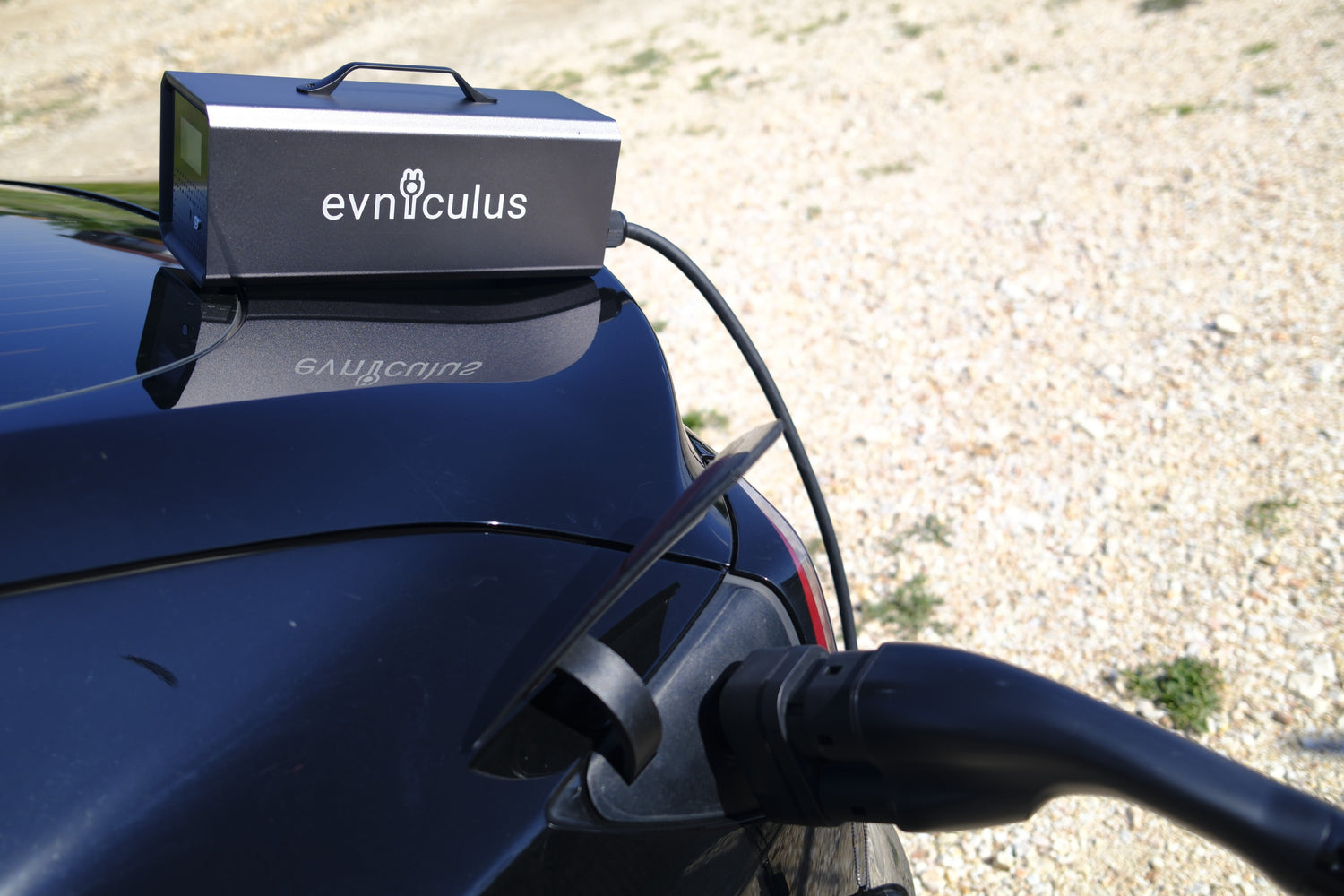
The adapter connects to the vehicle’s charging port and provides a standard AC outlet. Depending on the country and the vehicle, that outlet may be 120V or 230V. From the user’s side, the process feels simple: plug the adapter into the port, connect the device, turn on V2L if the car requires confirmation, and use the stored energy from the battery.
Behind that simple process, the car is doing the serious work. In models such as the Hyundai Ioniq 5, Hyundai Ioniq 6, Kia EV6, and some Genesis vehicles, the vehicle already has the hardware and software needed to provide AC power. The external adapter is the bridge between the charging port and your appliance.
This is why compatibility matters more than shape. A connector may fit into the port and still not work. The car must support power output, the adapter must be designed for that port, and the outlet must match the electrical standard of your region.
The real meaning of the vehicle to load
Vehicle to Load is one of the most useful ideas in modern electric driving because it changes how we think about the battery. Usually, the battery is there to move the car. With V2L, part of that energy can be used outside the car.
That does not mean the EV becomes a full replacement for a home backup system. It means the vehicle can supply practical AC power for selected devices within a defined limit.
A small LED light may draw only a few watts. A laptop charger may need 60 to 100 watts. A portable fridge may use more while the compressor starts, then much less while running. A kettle, heater, microwave, or power tool can be far more demanding. V2L is useful because the battery capacity is large, but the output limit still has to be respected.
A helpful way to think about it is this: the EV battery may hold tens of kilowatt-hours of energy, but the V2L outlet can only deliver a certain amount of power at one time. Capacity and output are related, but they are not the same thing.
How an electric vehicle becomes a portable AC power source?
An electric vehicle stores energy as DC power in its high-voltage battery. Most household appliances use AC power. The vehicle’s V2L system converts the battery’s energy into usable AC electricity, then sends it through the outlet on the adapter or built-in socket.
In many V2L-compatible cars, the driver can set a minimum battery level before using the function. This is one of the most practical safety features. If you set the discharge limit at 40%, the car will stop supplying power when the battery reaches that level. You can use appliances without accidentally draining the battery below the point you need for driving.
The exact process depends on the model, but it usually follows the same pattern. The charging port is opened, the adapter is connected, the appliance is plugged in, and V2L is activated through the car or through the adapter’s switch. Some adapters also use an indicator light. Blue may mean standby on certain systems, green may mean the outlet is supplying power, and red may show that no power is being delivered or that there is a fault.
If the system stops working, the cause is often simple: too much load, low battery limit, heat, an unsafe connection, an open port cover, a switched-off connector, or a device with unusual startup demand.
What can you run with V2L?
V2L is best for practical, temporary power. It is excellent for the things people actually miss when they are away from a socket. You can usually run or charge devices such as phones, laptops, tablets, routers, LED lamps, camera batteries, e-bike chargers, small coolers, compact fridges, fans, speakers, projectors, air pumps, and some lightweight tools.
Some appliances need more care. Coffee makers, kettles, heaters, microwaves, large compressors, and power tools can draw a lot of electricity. Even when the listed wattage looks acceptable, startup power can be higher than expected. A fridge or pump may briefly pull more power when the motor starts. If that spike is too high, the vehicle may cut the output.
Before plugging in multiple devices, add up their wattage. If you use an AC cable or extension lead, it should be rated for the load, suitable for the environment, and fully uncoiled during use. A weak cable can heat up, especially when a device runs for hours.
Power limits and technical characteristics to check
V2L output varies by vehicle, market, and adapter. In 230V markets, Hyundai and Kia V2L systems are often associated with output up to around 3.6 kW. In North America, some external adapters for Hyundai Ioniq 5, Ioniq 6, and Kia EV6 are rated at 15A and 120V, which is around 1.8 kW.
These differences matter because the same car family may not behave exactly the same way in every region. Before buying or using a V2L product, check these technical points:
|
Technical point |
Why it matters? |
|
Vehicle support |
The EV must support V2L or compatible discharge function |
|
Connector type |
J1772, Type 2, CCS, CHAdeMO and NACS are not interchangeable |
|
Output voltage |
Usually 120V in North America or 220-240V in many other regions |
|
Maximum current |
Often 15A or 16A, depending on the adapter and market |
|
Maximum output |
Commonly around 1.8 kW to 3.6 kW for factory-style V2L use |
|
Outlet type |
The plug must match your appliances and region |
|
Battery discharge limit |
Helps keep enough charge for driving |
|
Cable rating |
A poor AC cable can overheat or reduce performance |
|
Weather protection |
Outdoor use requires extra care around rain, mud and humidity |
|
Warranty position |
Unsupported adapters may create problems if damage occurs |
These details are not there to make the process complicated. They simply prevent the most common mistake: buying a product that looks right but does not match the vehicle’s actual V2L system.
Why is V2L so useful on camping trips?
V2L makes the most sense when there is no reliable outlet nearby. That is why it fits so naturally into camping trips, outdoor events, and long road stops.
A quiet electric car can power a light beside the tent, keep food cold in a portable fridge, charge a camera after a day outside, run a small induction plate for short cooking, or keep a laptop alive if someone needs to work remotely. There is no petrol smell, no generator noise, and no need to carry fuel.
The best setup is usually modest. One or two useful devices. A suitable cable. A dry position. A battery limit that still leaves enough range for the next day. V2L is at its best when it supports the trip without turning the car into a moving power station for everything at once.
A longer cable can help if the vehicle is parked away from the table, tent, or cooking area. Some V2L setups can be used with cables reaching several meters, and in certain cases up to around 15 meters, but length should never come at the expense of rating and safety. The longer the cable, the more important cable quality becomes.
Compatibility: Hyundai, Kia, Genesis, NACS, Lectron, and VW ID.4
Compatibility is the part buyers should slow down for. The EV world has too many similar-looking connectors and too many regional differences to guess.
Hyundai Ioniq 5, Ioniq 6, Kia EV6, and Genesis GV60/GV70 are among the most discussed models because they are known for practical V2L use. An EV6 V2L adapter, for example, is typically designed to connect to the external charging port and provide an AC outlet, as long as the vehicle and market support that function.
The Lectron V2L adapter is often searched because it is a popular North American option for Hyundai Ioniq 5, Hyundai Ioniq 6, and Kia EV6. Its typical rating is 15A at 120V, or about 1.8 kW, with a NEMA 5-15 outlet. That makes it suitable for many small appliances and outdoor devices, but not for every high-demand load.
A NACs v2l adapter needs even more attention. NACS is now widely discussed because more North American EVs are moving toward that inlet, but a NACS charging adapter and a NACS V2L adapter are not the same thing. One helps bring electricity into the car. The other is meant to take electricity out. Some newer Hyundai and Genesis models are expected or advertised with NACS-related V2L options depending on model year and market, but owners should confirm exact compatibility before ordering.
The search for a VW ID 4 v2l adapter is a good example of why wording matters. Some Volkswagen ID. models support bidirectional charging or Vehicle-to-Home functions in certain markets, battery versions, and software conditions. That is different from a simple external V2L adapter that plugs in and gives you a household outlet. With VW ID.4, the safer assumption is that owners need to check model year, software version, battery size, region, and required home-energy equipment before expecting V2L-style use.
At EVniculus, we look at V2L from this practical angle first: the right solution is not the one that sounds most powerful, but the one that matches the vehicle, connector, voltage, safety limits, and the way the driver will actually use it.
V2L adapter or V2L discharger?
The word “adapter” gets used loosely, but there are two different ideas here. A basic V2L adapter is usually compact. It fits in a glove box or small storage case. It works with a vehicle that already supports V2L and provides a household-style outlet from the charging port. The car manages the conversion, battery protection, and output control.
A V2L discharger can be more complex. It may include its own inverter and may be designed for vehicles where power needs to be converted through external electronics. These devices are usually larger, more technical, and more model-specific. They may also have stricter conditions for use.
This difference is especially important for Tesla, CHAdeMO, CCS, and NACS discussions. A driver may ask for an adapter, but the actual solution may need to be a discharger. Or the vehicle may not support safe external discharge at all. The question should always be: what does this specific car allow?
Using V2L during emergencies
V2L is not only for travel. During a short power outage, it can be genuinely useful. A fridge, lamp, router, phone charger, radio, or laptop can make a house feel far more manageable when the grid is down. For people who live in areas with storms, unstable supply, or remote properties, V2L can be a practical backup layer.
Still, it should be used with a clear head. Do not backfeed a house through a wall outlet. Do not improvise with unsafe wiring. Do not connect V2L to home circuits unless the setup is designed and installed for that purpose. Standard V2L is for plugging devices into the outlet, not for energizing a household electrical panel.
Medical equipment deserves even more caution. V2L can help in an emergency, but essential medical devices should have a proper backup plan because vehicle output can stop if the battery reaches the discharge limit, the circuit overheats, the load is too high or the connector is disconnected.
Can V2L charge another electric vehicle?
In some cases, yes, but expectations should be modest. V2L can sometimes provide a small emergency top-up to another EV through compatible portable charging equipment. This can be helpful if a stranded car only needs a little energy to reach the nearest charging station. It is not a fast solution, and it is not a replacement for a real charger.
The power level is usually too low for convenient EV-to-EV charging. It can work as a last resort, not as a normal charging method. The adapter, cable, receiving vehicle, and portable EVSE all need to be suitable for the job.
Safety habits that matter
V2L is easy to use, but it is still electricity. Good habits make a big difference. Keep the adapter dry. Avoid puddles, snow, mud, and exposed metal surfaces. Do not place the connector where someone can step on it, drive over it, or pull it out by accident. If you are in a public place, think about theft as well. A visible adapter and cable left unattended can attract attention.
Use appliances that are within the limit of the car and the adapter. If the adapter is rated for 15A, do not treat it like a heavy workshop circuit. If the vehicle guidance says to stay below 16A, respect that number. If a device smells hot, sounds wrong, or repeatedly trips the V2L output, disconnect it.
Unplug appliances before switching V2L off. Let the adapter cool before storing it if it has been under load for a long time. Keep it in a protective case, trunk organizer, or glove box so the connector is not damaged. Small things matter here. A clean port, a good cable, and a dry surface can prevent most problems.
What to confirm before purchase?
Before ordering any V2L product, confirm the details in this order. First, check whether the vehicle supports V2L, V2H, or another bidirectional function. These are related ideas, but they are not identical.
Second, confirm the port type. A Type 2 adapter will not solve a NACS problem. A charging adapter will not necessarily work for power output. A CCS vehicle may need a completely different solution from a J1772 V2L setup.
Third, check the output voltage and outlet type. A 120V North American adapter is not the same as a 230V European setup. The appliance plug, voltage, and frequency must match. Fourth, check the power limit. If you want to run a mini-fridge, laptop, and lights, most compatible V2L systems will likely cope. If you want to run a heater, power saw, or large microwave, check the numbers carefully. Fifth, think about the use case. Camping, road trips, light work, tailgating, and emergency backup all have different needs. A compact adapter may be ideal for one driver, while another may need a more capable discharger.
Making the Most of Your EV’s Stored Power
V2L is one of those EV features that feels small until it becomes useful. Then it changes the way the car fits into everyday life. It can make camping quieter, road trips easier, and power outages less stressful. It can turn a parked vehicle into a portable power source for light, communication, cooling, tools, and essential devices. It can also reduce the need for noisy fuel generators in many outdoor situations.
The only real condition is that everything has to match. The vehicle must support output. The adapter must fit the right port. The voltage and current must suit the appliance. The cable must be safe. The battery limit must leave enough range for the drive home.
When those pieces line up, V2L is not just a technical feature. It is one of the most practical ways to use the energy already stored inside an electric vehicle.
FAQ
What does a V2L adapter do?
A V2L adapter allows a compatible electric vehicle to send power from its battery to external devices. In simple terms, it transforms the car into a portable AC power source for lights, laptops, chargers, small fridges, routers, tools, and other appliances that stay within the allowed output limit.
Can every electric vehicle use Vehicle to Load?
No. The vehicle must support Vehicle to Load before an adapter can work. A connector may fit the port, but that does not mean the car can safely supply electricity from the battery. Always confirm the vehicle model, software, market, port type, and output rating before purchase.
What is the vehicle-to-load V2L useful for?
Vehicle-to-load V2L is useful for camping, road trips, tailgating, outdoor work, and emergencies. It can power practical devices when there is no wall outlet close at hand, such as a phone charger, laptop, compact cooler, LED light, router, or small cooking appliance.
How much power can I use from a V2L adapter?
The answer depends on the vehicle and adapter. Some systems offer around 1.8 kW in 120V markets, while others can reach about 3.6 kW in 230V markets. Power consumption matters more than the number of devices. Several small devices may be fine, while one heater or kettle may be too much for the circuit.
Can I use several outlets with V2L?
You can use several outlets only if the total load stays within the adapter and vehicle limit. A multi-outlet strip does not increase available power. As a safety note, avoid running the system close to its maximum rating for long periods, especially with long cables, wet conditions, or devices with high startup demand.
What happens if my EV battery is at half charge?
If the battery is at half charge, V2L can still be useful, but the discharge limit becomes important. Set a battery level that leaves enough range for the next drive. The car may stop supplying power automatically once that limit is reached, which helps protect the remaining driving range.
Is a NACS V2L adapter the same as a NACS charging adapter?
No. An NACS charging adapter helps bring electricity into the vehicle. A NACS V2L adapter is designed to take electricity out of the vehicle and supply external devices. Some newer products are released for specific model years and markets, so owners should confirm compatibility before ordering.
Does a V2L adapter work in Canada?
It can, but only if the adapter matches the vehicle, connector, and local electrical standard. If a product ships to Canada, that does not automatically mean it works with every Canadian EV. Check the outlet type, voltage, amperage, vehicle support, and warranty conditions before purchase.
Should I trust a compatibility video before buying?
A video can be helpful because it shows the process in real use, but it should not replace the technical specifications. The safest approach is to check the vehicle model, port, voltage, maximum current, supported appliances, and adapter type. If the product details are unclear, contact the seller before you purchase.
Can I cancel an order if I choose the wrong adapter?
That depends on the store policy and whether the product has already shipped. If you are not sure about compatibility, it is better to pause before buying. A nice-looking listing from any brand is not enough. The adapter must match the car, the port, the output limit, and the devices you plan to run.
Is V2L better for the planet than a generator?
For many light outdoor uses, yes. V2L can reduce the need for a small fossil-fuel generator, especially during camping trips, road trips, or short power outages. It is quiet, produces no local exhaust fumes, and uses energy already stored in the EV battery.
Can V2L power a whole house?
Standard V2L is not designed to power a whole house. It is meant for selected appliances plugged directly into the outlet. Feeding power into home wiring requires dedicated bidirectional charging equipment, proper protection, and professional installation.