Updated on 12.10.2026
You want to charge an electric bike during a stop or set up a small workspace beside your car. The battery has enough charge, the charger has a household plug and the accessory appears to fit the vehicle’s charging port. Yet these three details alone do not confirm that the setup will work.
A V2L adapter provides access to an electrical supply for external devices within a compatible setup. To choose the right one, you need to check three things: the function available on the car, the role of the accessory and the requirements of the device you want to power.
What Does V2L Mean?
V2L stands for Vehicle-to-Load: electricity flows from the vehicle to an electrical device. The battery supplies the energy needed to run a laptop, lighting, an electric bike charger or another compatible appliance.
In a vehicle with built-in V2L, the onboard electronics convert the battery’s direct current into alternating current that appliances can use. The external accessory provides access to this output and helps activate the function designed by the manufacturer.
The Kia EV6 illustrates this arrangement. Its documentation describes an external power supply used with an adapter, alongside a socket inside the cabin, with an output of up to 3.6 kW.
A large battery therefore does not establish compatibility on its own. The vehicle needs an appropriate discharge function and an interface suited to the intended use.
Two Types of Accessories to Distinguish
The accessory’s role depends on your vehicle’s built-in capabilities. Some adapters enable an existing V2L function, while external dischargers use their own inverter to convert the battery’s DC power into AC power.
An Adapter for a Built-In Vehicle Function
On a vehicle with built-in V2L, the accessory connects to the designated port and makes the electrical output available. The vehicle handles the main power conversion.
Its external shape may resemble an accessory intended for another brand. Compatibility still depends on the manufacturer’s specifications and the particular product used. A connector that physically fits is only the first check.
A Discharger with an External Inverter
Other devices contain their own DC-to-AC inverter. They access energy from the battery through a compatible connection, then produce alternating current for external appliances.
This arrangement requires additional checks: input voltage range, communication with the vehicle, output power, cooling and electrical protection. It explains why a small Type 2 adapter and an external discharger perform different functions.
V2L Socket: Identify Both Sides of the Connection
The term V2L socket can refer to the household-style outlet used to connect an appliance or, more informally, the point where the accessory connects to the vehicle.
To avoid ordering the wrong product, distinguish between these two sides. On the vehicle side, identify the actual port and interface being used. On the appliance side, check the plug format, voltage, frequency and earthing requirements.
|
Vehicle setup |
Main check |
Accessory to look for |
|
Built-in V2L function |
Vehicle equipment and specified accessory |
Adapter designed for that function |
|
Officially documented Tesla function |
Applicable model, configuration and market |
Corresponding manufacturer accessory |
|
Tesla power supply through an external device |
Interface, battery voltage and confirmed compatibility |
Discharger with a suitable inverter and electrical protection |
Two accessories with household-style outlets can therefore serve different vehicle configurations.
How Do You Check Your Car’s Compatibility?
Start with the owner’s manual for your vehicle. Look for Vehicle-to-Load, its activation requirements and the recommended accessory. Also check whether your trim includes the necessary equipment.
Some functions depend on an option. BMW, for example, states that its Vehicle-to-Load adapter requires AC Charging Professional equipment on the applicable vehicles. The vehicle range alone therefore does not confirm availability.
The accessory’s product reference matters too. In its V2L manual, Renault specifies the connector supplied with the vehicle or by its representative, developed specifically for that application.
Before buying, gather the model, model year, original sales market and trim details. A photograph of the inlet helps identify the connection, while the manual and equipment specifications confirm the function.
If the documentation remains unclear, request written confirmation covering your vehicle configuration and the exact accessory.
Tesla V2L: Manufacturer Functions and External Solutions
Tesla V2L compatibility needs to be assessed by model, configuration and market. Three situations should be distinguished.
The Cybertruck has the Powershare functions described by Tesla. Supplying a home involves a complete system and dedicated equipment.
The US owner’s manual for certain Model Y configurations also describes using a Tesla Outlet Adapter. Availability depends on the region and vehicle configuration. Depending on that configuration, the accessory works independently or requires the third-generation Mobile Connector. This documentation does not establish general availability on European Model Y vehicles.
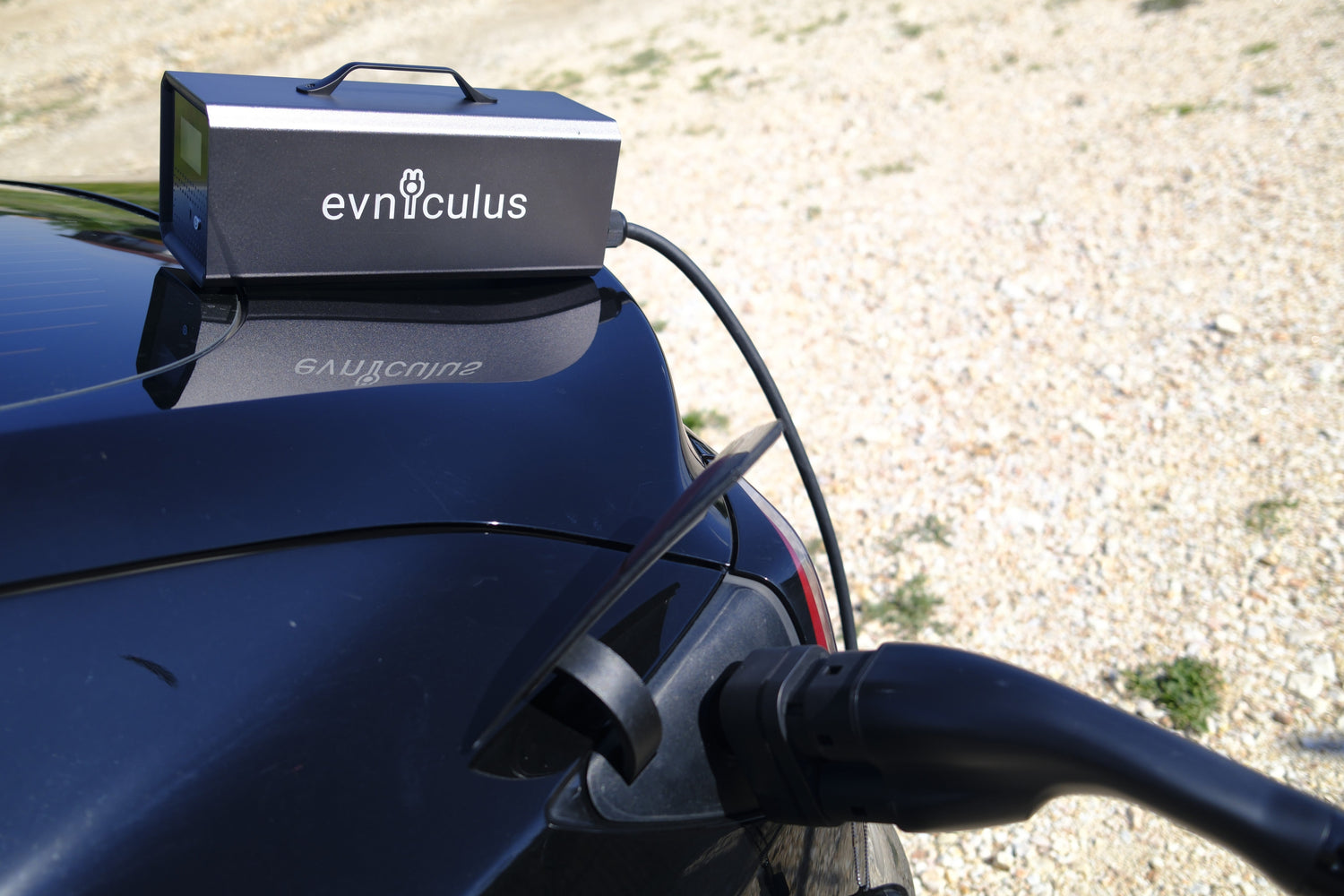
Third-party dischargers also offer an external power supply for certain compatible Tesla vehicles. They use a separate inverter and must be assessed according to their own specifications.
For a European vehicle, first identify which of these arrangements applies to your car. You can then assess the appropriate accessory.
V2L for Tesla: What to Check Before Buying
If you are considering V2L for Tesla, specify the model, year, original market, charging port and software version. Depending on the device, CCS support may also need to be confirmed.
The discharger must accept the battery’s actual voltage. An advertised input range of 300–500 V must be compared with the vehicle’s electrical specifications; the connector’s shape cannot establish compatibility here.
Also ask whether compatibility has been confirmed for your software configuration. Vehicle updates may change how a third-party accessory operates.
Finally, review the warranty conditions. The French Model 3 owner’s manual warns that using the battery as a stationary power source would void the warranty. Ask Tesla to clarify the conditions applicable to your vehicle and intended use.
Which Devices Can You Power?
Check their electrical specifications before connecting them. Total permitted power, the limit of each outlet and startup current must be compatible with the system.
A motor or compressor may require more power when starting than during steady operation. Some appliances may also have specific requirements listed in their manuals.
For a charger, check its mains input specifications. The voltage stated at its output relates to the device being charged and does not, by itself, describe the power drawn from the socket.
Consider a hypothetical example: a laptop drawing 90 W, lighting drawing 30 W and an electric bike charger drawing 200 W require 320 W in total. At a constant consumption over two hours, this amounts to 0.64 kWh.
Actual energy use also includes conversion losses and the electricity consumed by the vehicle’s active systems. Keep enough charge in reserve to continue your journey and check the discharge cutoff setting available on your configuration.
Prepare the Setup According to the Instructions
Position the vehicle and accessory as instructed. Follow the required connection sequence, activation conditions and locking instructions.
Before each use, inspect the contacts and cables. Permitted moisture exposure, ventilation and outlet protection must comply with the equipment’s instructions. An external discharger may have different requirements from a manufacturer’s adapter.
Pay particular attention to earthing and residual-current protection requirements. Have an electrician verify these points where the device requires specific electrical preparation.
V2L supplies appliances within the intended setup. Do not connect its output to a wall socket to feed electricity back into the house. Supplying a home’s electrical installation requires a system designed for that purpose and professional installation.
Choose According to Your Actual Needs
For occasional use with a few appliances, start with their electrical requirements and the function available on your car. A high advertised power rating provides limited information if vehicle compatibility remains uncertain.
Then compare the instructions, product references, limits per outlet and operating conditions. Size, weight and the ability to keep the equipment dry also matter when using it outdoors.
At EVniculus, we help you identify the type of accessory suited to your vehicle. Send us its specifications and a list of the devices you want to power so we can assess the appropriate setup.
Frequently Asked Questions
Is a Type 2 Inlet Enough to Make a Car Compatible?
A Type 2 inlet identifies a charging interface. V2L must be supported by the vehicle or provided through an external device whose compatibility has been confirmed.
Can You Use the Same Accessory Across Different Brands?
That depends on the product and the vehicles explicitly listed as compatible. Check each configuration, even where the ports look similar. Follow the vehicle manufacturer’s requirements.
What Should You Do If the Function Does Not Start?
Record the displayed message, battery charge level and equipment details. Check the activation requirements in the instructions, then contact the relevant support team if the problem continues.
Sources
- Kia France: “Kia EV6 réinvente l’expérience d’utilisation des véhicules électriques”, covering V2L operation and the ICCU module.
- BMW France: Documentation for the Vehicle-to-Load adapter and AC Charging Professional equipment.
- Renault: Owner’s manual, “Fonction Vehicle to Load (V2L)”.
- Tesla: Official Powershare documentation.
- Tesla: US Model Y owner’s manual, “Powering Devices Using the Charge Port”.
- Tesla: French Model 3 owner’s manual, “Informations sur la batterie haute tension”.