
Updated on 15.07.2026
CCS1 and CCS2 are regional versions of the same charging system, not two different levels of fast charging. CCS1 combines a Type 1, or SAE J1772, AC connector with two DC contacts. CCS2 follows the same principle but builds on the European Type 2 connector. The plugs have different shapes and pin arrangements, so they cannot connect directly to one another.
For anyone comparing CCS1 vs CCS2, that is the essential difference. CCS1 is primarily associated with North America and South Korea, while CCS2 is the dominant standard across Europe and is widely adopted in Australia, India, parts of the Middle East, South America and other global markets.
The distinction matters most when an electric vehicle has been imported or moved between regions. Two versions of the same model may leave the factory with different vehicle inlets. At EVniculus, we help drivers identify the connection fitted to their car and match it with the right charging equipment or adapter.
How Does the Combined Charging System Work?
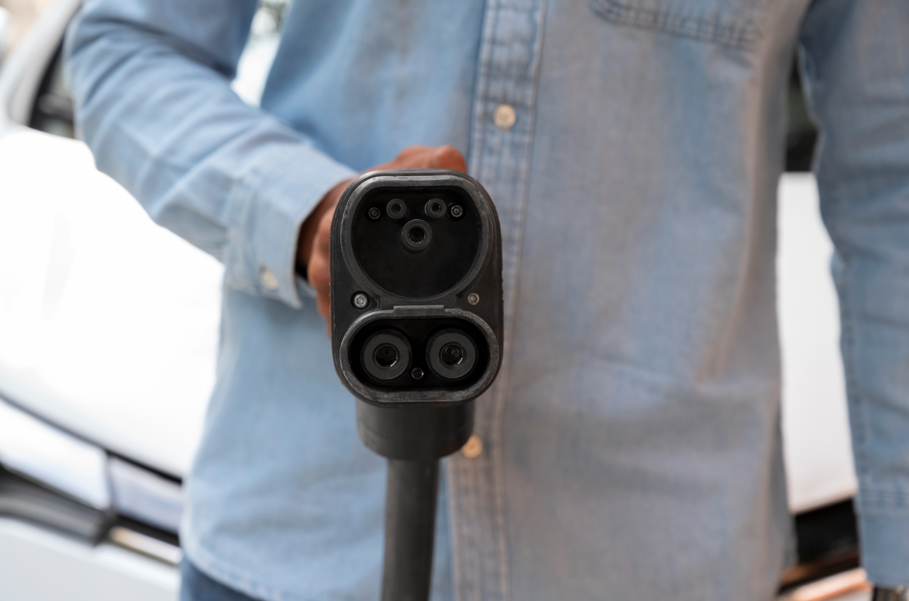
The Combined Charging System was designed to give electric vehicles a single vehicle inlet for both AC and DC charging. For home charging or slower public charging, the cable uses the AC section at the top of the inlet. A DC fast charger adds two larger contacts below it and delivers direct current to the battery without relying on the car’s onboard AC charger.
This shared layout is where the word combined comes from. CCS1 integrates Type 1 AC charging with DC fast charging, while CCS2 integrates Type 2 AC charging with the same broad DC concept. The physical connector types are different, but the system architecture is closely related.
CCS also covers more than the shape of the plug. It includes safety signaling, charge control and communication between the vehicle and the charging station. Control Pilot signaling establishes the basic connection, while power-line communication allows the car and charger to exchange data through standards such as DIN SPEC 70121 and ISO 15118. This communication helps them agree on voltage, current, and charging power before energy begins to flow.
The system supports bidirectional data exchange. Bidirectional charging, where the car can return electricity to a building or the grid, is a separate capability and requires compatible vehicle hardware, charging equipment and software. A CCS port alone does not guarantee vehicle-to-grid operation.
Why CCS Developed into Two Regional Charging Standards
The European automotive industry recommended Type 2 and Type 2 Combo as the common interface for Europe in 2011. CCS was selected as an SAE charging solution in North America in 2012, where the established Type 1 connector became the foundation for Combo 1.
The European Union later made Combo 2 the minimum connector for interoperable public DC charging infrastructure. That requirement continues under Regulation (EU) 2023/1804, helping CCS2 remain the dominant fast charging standard across the EU.
The hardware continues to evolve. IEC 62196-3:2026, published in April 2026, is the current international standard covering dimensional compatibility for DC and combined AC/DC vehicle couplers. Its latest edition introduces increased ratings and incorporates updated requirements for high-power charging equipment.
CCS1 and CCS2: Key Differences at a Glance
|
Feature |
CCS1 |
CCS2 |
|
Alternative name |
Combo 1 |
Combo 2 |
|
AC connector |
Type 1 / SAE J1772 |
Type 2 / Mennekes |
|
AC supply |
Primarily single-phase AC |
Single-phase or three-phase AC |
|
DC design |
Two additional DC pins |
Two additional DC pins |
|
Total contact positions |
Seven |
Nine |
|
Main regions |
North America and South Korea |
Europe and many other global markets |
|
Direct cross-compatibility |
No |
No |
|
Communication |
PLC, DIN SPEC 70121 and ISO 15118 |
PLC, DIN SPEC 70121 and ISO 15118 |
Connector Design: How CCS1 and CCS2 Differ
The upper part of a CCS1 inlet follows the five-contact Type 1 design. It contains the AC power contacts, protective earth, and signaling contacts. Two large DC pins sit below this section. During DC fast charging, the lower pins carry the high-power direct current, while the smaller contacts manage communication and safety functions.
A CCS1 charger is commonly found at North American public stations operated by networks such as Electrify America and ChargePoint. Many North American versions of the Chevrolet Bolt, Audi e-tron and other electric cars were produced with CCS1 inlets. The exact port should still be checked because EV manufacturers may use a different regional standard for the same model.
The CCS2 connector is based on the seven-position Type 2 AC design. Once the two DC contacts are added, the complete inlet has nine contact positions. Not every contact carries power during a DC session. Several remain responsible for grounding, proximity detection, and communication.
What is CCS2 in practical terms? It is the European implementation of the Combined Charging System, bringing Type 2 AC charging and high-power DC charging into one inlet. Type 2 also supports three-phase AC charging, although the actual AC charging speed depends on the onboard charger fitted to the vehicle.
European versions of the Audi e-tron and Mercedes-Benz EQC commonly use CCS2. The Nissan Leaf is an important exception: many generations were equipped with a Type 1 AC port and a separate CHAdeMO inlet for DC charging. This is why the model name alone cannot reliably identify the charging standard.
Where Are CCS1 and CCS2 Used?
CCS1 became widely adopted across the United States and Canada and is also used in South Korea. It remains available at thousands of North American charging points and is fitted to a substantial number of existing vehicles. Newer North American models are moving towards SAE J3400, previously known as NACS, but CCS1 will remain relevant for the installed vehicle fleet and public charging infrastructure for years.
CCS2 is the standard connection across the European Union and the United Kingdom. It is also commonly found in Australia, India, South Africa, Saudi Arabia and a growing number of global markets. China should not be grouped into this CCS2 region: GB/T is the country’s mandatory national charging standard. Japan has historically relied on CHAdeMO, although newer vehicles are gradually broadening the range of available connections.
A CCS2 charger is therefore the expected choice at most European DC charging stations. Imported North American electric vehicles may still use those stations, but they require a correctly rated CCS2-to-CCS1 adapter.
Does CCS2 Have a Faster Charging Speed Than CCS1?
Neither connection is inherently faster. Both CCS1 and CCS2 support DC fast charging, including high-power and ultra-fast charging. Stations commonly deliver power levels between 50 kW and 350 kW, while some modern equipment can reach 400 kW or more. The connector family does not decide how much of that power reaches the battery.
Charging speed is limited by the lowest-capacity component in the session. A 350 kW station cannot make a vehicle rated for 150 kW charge at 350 kW. Battery voltage, temperature, state of charge and the vehicle’s charging curve also change the power throughout the session.
The same rule applies when an adapter is added. If the car can accept 250 kW but the adapter is rated for 200 kW, the adapter becomes the relevant limit. A suitable high-power fast charging station can often take a modern EV from 10% to 80% in less than an hour, but that is not guaranteed. A large battery connected to a 50 kW DC fast charger may need considerably longer.
Do CCS1 and CCS2 Offer Backward Compatibility?
There is useful backward compatibility within each regional design. A Type 1 AC plug can connect to the AC section of a CCS1 inlet, while a Type 2 plug can connect to the upper section of a CCS2 inlet. This allows both AC home charging and DC rapid charging through one port.
There is no direct backward compatibility between CCS1 and CCS2. Their connector design and pin arrangement prevent a CCS1 plug from entering a CCS2 vehicle inlet or the reverse. An adapter is needed to bridge the physical difference and preserve the required signal path.
A CCS2-to-CCS1 adapter connects a CCS2 station cable to a vehicle with a CCS1 port. This is the usual solution for a North American or South Korean vehicle used in Europe. The reverse CCS1-to-CCS2 adapter allows a CCS2-equipped car to use a CCS1 charging station. Some adapters support DC charging only, while others handle both AC and DC, so the product specification must be checked carefully.
Where Do NACS Adapters Fit into Electric Vehicle Charging?
North America is moving from CCS1 towards SAE J3400. Many automakers are introducing the smaller NACS-style inlet on newer vehicles, while existing CCS1 cars continue to rely on adapters when using compatible NACS charging stations.
A NACS-to-CCS1 adapter connects a NACS DC charging cable to a CCS1-equipped vehicle. EVniculus offers a model rated for up to 500 A and 1000 V DC, with dual locking and temperature protection. Access to a particular charging network still depends on the vehicle, station and network authorization; the adapter does not bypass software restrictions.
A CCS1 to NACS adapter works in the opposite direction. It allows an electric vehicle with a NACS inlet to connect to a CCS1 DC fast charger. Our current 500 A, 1000 V DC model includes an automatic temperature cut-off and is designed for use with compatible NACS vehicles at CCS1 public stations.
The direction matters. An adapter designed for CCS1 power delivery to a NACS vehicle cannot simply be turned around and used for the reverse connection.
How to Choose the Right CCS Adapter
Start with the vehicle, not the station. Confirm the original market, model year, and actual vehicle inlet. Then determine whether you need AC charging, DC charging or both. The adapter’s rated voltage, current and power must meet the demands of the car and the charging equipment.
Thermal protection is especially important during high-power DC charging. Secure locking, durable contacts and resistance to dust and moisture also matter because every additional connection introduces another possible point of heat or electrical resistance. Stop using an adapter if the housing, pins or locking mechanism show damage, and never stack multiple adapters unless the manufacturers explicitly approve that configuration.
At EVniculus, we recommend checking compatibility before ordering rather than relying on the model badge alone. If the port is unclear, the vehicle’s year, original market and a clear photo of the inlet are usually enough for us to identify the correct solution. The right adapter does not increase the car’s charging capability. It gives the vehicle safe access to a charging standard it was not physically designed to accept.
Frequently Asked Questions
Is CCS2 the same as Type 2?
No. Type 2 refers to the AC connector. CCS2 combines the Type 2 AC section with two additional DC contacts for fast charging.
Can a CCS1 vehicle use a CCS2 charging station?
Yes, if the vehicle and station are technically compatible and a correctly rated CCS2-to-CCS1 adapter is used. They cannot connect directly.
Is CCS1 being replaced by NACS?
New North American models are increasingly adopting SAE J3400/NACS, but CCS1 remains widely used by existing vehicles and public charging networks.
Which is better, CCS1 or CCS2?
Neither is universally better. CCS2 offers three-phase AC capability and is the established European standard. CCS1 was designed around the North American Type 1 system. The correct choice is the one fitted to the vehicle and supported by the local charging infrastructure.
Can One CCS Vehicle Inlet Handle Both AC and DC Charging?
Yes. One of the key features of CCS is that a single vehicle inlet supports both AC and DC charging. For home charging, the car uses the Type 1 or Type 2 AC connector in the upper section. At a DC fast charging station, the connector also engages the two DC contacts below it. This design removes the need for separate AC and DC inlets and gives drivers access to different charging power levels through one port.
How Is CCS Different from CHAdeMO?
CHAdeMO is designed for DC charging and requires the vehicle to have a separate AC connector for home or destination charging. CCS integrates both functions into one inlet. Earlier Nissan Leaf models are a familiar example of the CHAdeMO layout, with one connection for AC charging and another for rapid charging. CCS has become more widely adopted among new electric cars in Europe and North America, while CHAdeMO is now found mainly on older models and selected Japanese vehicles.
Can Most Electric Vehicles Use the Full Power of a 350 kW CCS Charger?
Most electric vehicles equipped with a compatible CCS port can connect to a 350 kW DC fast charger, but relatively few can accept its full power. The vehicle decides the maximum current and voltage it can safely receive. Battery temperature and state of charge also affect charging speed. A car rated for 150 kW will therefore remain close to that limit even when connected to a higher-powered unit. The advantage of 350 kW public charging points is that they can serve vehicles with very different capabilities while allowing newer high-power models to charge closer to their maximum rate.
Sources of Information:
1. CharIN – Frequently Asked Questions about the Combined Charging System
2. IEC – IEC 62196-3:2026
3. ISO – ISO 15118-2:2014
4. European Union – Regulation (EU) 2023/1804
5. SAE International – SAE J3400/2 Standard
6. U.S. Department of Energy – Electric Vehicle Charging Stations
7. NREL and ChargeX – Recommended Actions to Improve Adapter Safety