
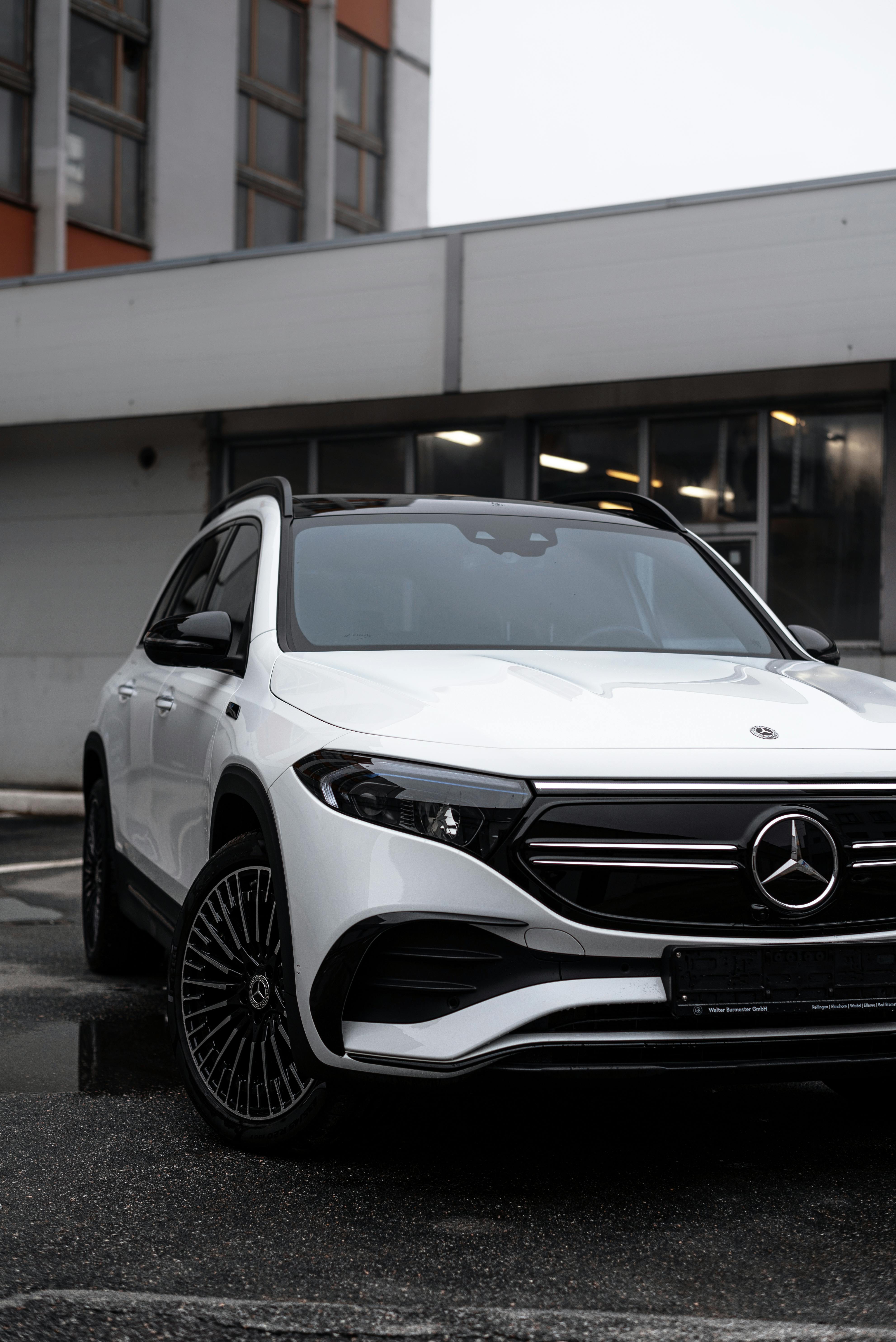
When we look at the Mercedes EQA, we do not see a car that should be judged only by its headline range figure. We see a compact all electric car that needs to fit into a real routine: commuting, school runs, mixed driving, weekend trips, public charging stops and the quiet habit of plugging in at home when the day is done.
That is where the Mercedes Benz EQA makes most sense. It sits in a practical part of the Mercedes electric cars range. It is compact enough for urban and suburban use, comfortable enough for longer daily journeys, and familiar enough for drivers moving from a GLA or another compact Mercedes. At the same time, the electric motor, battery capacity, regenerative braking and charging routine change the way the car should be owned.
For many drivers searching for EQA Mercedes information, the important questions are not only about badge, trim or design. They are about range, boot space, rear seats, wall box charging, public charging, cable compatibility and whether the car’s everyday energy use will suit the way they drive.
For 2026 buyers, the EQA is best understood as a comfort-led compact electric SUV rather than a radical dedicated-platform EV. It feels premium in the places many owners notice first, but it is not the roomiest electric SUV in its class. It is easy to drive, but not especially sporty. It can work well for private buyers, used Mercedes customers and company car drivers, provided the charging setup is planned properly and expectations around real world range are realistic.
Mercedes Benz EQA Performance Overview: EQA 250 Range, Battery Capacity and Electric Motor
The current UK EQA models are mainly built around three versions: the EQA 250+, EQA 300 4MATIC and EQA 350 4MATIC. The EQA 250+ uses a 70.5 kWh battery and front wheel drive, while the EQA 300 4MATIC and EQA 350 4MATIC use a 66.5 kWh battery with all wheel drive.
The EQA 250+ is the range-focused model. It sends electric power to the front wheels, which helps efficiency and keeps the car relatively simple mechanically. In everyday use, this is the version we would expect to suit drivers who care more about maximum range, lower energy use and predictable commuting than outright acceleration.
The EQA 300 4MATIC and EQA 350 4MATIC add all wheel drive and stronger performance. They are better suited to drivers who regularly deal with wet roads, hills, winter conditions or heavier use, but the extra drivetrain hardware affects the EQA range. In real life, that difference matters more on motorway routes than on short urban journeys
Mercedes-Benz EQA figure
70.5 kWh
66.5 kWh
311–346 miles WLTP for EQA 250+
258–266 miles WLTP
190 hp, 228 hp or 292 hp depending on model
Front wheels for EQA 250+;all wheeldrive for 4MATIC models
145–185Wh/km depending on trim and specification
8.6 sec, 7.7 sec or 6.0 sec
99 mph
11 kW
100 kW
10–80% in 32–35 minutes
We would treat the official WLTP figures as a useful comparison tool, not as a fixed daily promise. Bigger wheels, cold weather, air conditioning, heated seats, a full rear bench, roof accessories and a heavier right foot all affect how much energy the car uses. A calm driver on urban roads may see strong efficiency. A motorway driver in winter, using climate control and travelling at higher speed, should expect less.
That is normal for electric cars. Range is not one fixed number. It changes with driving style, road ahead, temperature, load and speed. For most EQA owners, the practical question is not “Will I always get the maximum range?” but “Can I cover my normal week comfortably with the charging access I have?”
Is the Mercedes Benz EQA a Good Car Among Electric Cars?
In our view, the Mercedes Benz EQA is a good car for a specific kind of buyer. It makes the strongest case for someone who values comfort, cabin quality, light steering, a familiar Mercedes layout and a relaxed driving experience. It is less convincing for someone who puts maximum space, lowest price or the longest possible range above everything else.
The EQA is priced in a competitive part of the market. Some rivals offer more boot space, more range or a more dedicated EV platform for similar money. That matters, especially for buyers comparing the EQA with cars such as the Tesla Model Y, Kia EV6, Volvo EX30 or Ford Mustang Mach-E. The EQA does not have the same luggage capacity as many rivals, and its modified GLA-based platform affects interior packaging compared with electric cars built from the ground up as EVs.
This does not make the EQA a weak car. It simply makes it a car with a particular character. It is quieter, more familiar and more compact than many larger electric SUVs. It does not try to feel futuristic for the sake of it. For drivers who want the three pointed star, a calm cabin and a manageable footprint, that can be part of the appeal.
For company car drivers, the ownership calculation can also be different. A fully electric Mercedes with zero tailpipe emissions can still sit in a favourable tax position compared with petrol and diesel cars, even as electric company car tax rates rise gradually. Private buyers may look more closely at purchase price and used Mercedes values, while fleet users may focus more on benefit-in-kind, charging access and predictable daily use.
EQA Features, AMG Line, Premium Plus and Interior Design
The EQA features list depends heavily on trim. The entry level EQA model line is more restrained, while AMG Line trim brings a sportier exterior and interior feel. AMG Line versions typically add AMG styling details, larger alloy wheels, sports seats, AMG floor mats and a multifunction sports steering wheel. AMG Line Premium and Premium Plus add more convenience and technology, including upgraded audio, wireless phone charging on selected trims, head up display on higher specifications and MBUX Interior Assistant gesture control where fitted.
The interior design is one of the EQA’s stronger arguments. The dual-screen dashboard gives the cabin a wide digital look, while MBUX handles navigation, charging information, media and vehicle settings. Smartphone integration includes Apple CarPlay and Android Auto, and the system can also support voice input through “Hey Mercedes”.
There is a useful EV-specific layer here. Navigation can show charging stations, range information, charging settings and remote charge status. That matters more than many new EV drivers expect. A good augmented reality navigation system or charging-aware route planner can reduce the mental work of longer journeys, especially when the driver is still learning how often to stop and which public chargers to trust.
Safety equipment is also part of the ownership value. The EQA has received a five-star Euro NCAP rating, with strong adult and child occupant protection scores. Standard and optional assistance systems may include Active Brake Assist, Active Lane Keeping Assist, Blind Spot Assist, Traffic Sign Assist, emergency call technology, Parking Package features, reversing camera or 360-degree camera depending on trim.
The car is not without compromise. The EQA is tuned more for comfort and refinement than enthusiastic driving. Light steering helps in town and makes parking easier, but body lean can be more noticeable if the road gets twisty. Premium Plus versions may include electrically adjustable damping suspension, yet adaptive dampers do not automatically make the car feel sharper. A test car on bigger wheels can sometimes ride less calmly than a simpler model on smaller alloy wheels.
The driving modes are useful rather than dramatic. Eco helps preserve more range. Comfort suits most daily journeys. Sport gives sharper throttle response when joining faster traffic. Regenerative braking can be adjusted through steering wheel paddles, allowing the driver to recover energy when slowing. In urban driving, this supports a more one pedal style, although the EQA should not be treated as a guaranteed full one-pedal car in every setting or software version.
Charging at Home: Selecting the Best Mercedes-Benz EQA Chargers
For most owners, the most important EQA ownership decision is not AMG Line or Premium Plus. It is charging. The right Mercedes-Benz EQA chargers make the car easier to live with because the weekly routine becomes predictable. You come home, plug in, schedule charging if needed, and start the next day with enough range.
The Mercedes-Benz EQA supports 11 kW AC charging and 100 kW DC charging in official UK technical data. The AC side matters most at home. A domestic socket can work as an occasional backup, but it is slow and should only be used where the socket and circuit are suitable. Extension cables should not be treated as a normal EV charging solution.
A wall box or suitable portable charger gives the owner better control over charging speed, cable handling and safety. On a three-phase supply, the EQA can use up to 11 kW AC. On many single-phase homes, practical charging may be closer to 7.4 kW. That is still enough for most overnight charging routines, especially because drivers usually top up what they used rather than charging from empty every day.
This is the part of EV ownership we think should be planned before the car arrives. The EQA is much easier to live with when the charging setup matches the driveway, the electrical supply and the driver’s mileage. A good charging routine removes a lot of anxiety from electric driving.
High-Speed AC Solutions for the Mercedes-Benz EQA: 11 kW Wall Box vs 22 kW Portable Charger
An 11 kW charging setup is the natural technical match for the EQA’s standard onboard AC charging capability. With the right three-phase supply, this allows the car to recover a large amount of range overnight and makes daily ownership simple for most commuting patterns.
A 22 kW charger does not automatically mean the car will charge at 22 kW. The onboard charger sets the limit. If the EQA can accept 11 kW AC, a 22 kW charge point will still be limited by the car to 11 kW.
That does not make a 22 kW portable charger useless. It can be useful for households with more than one EV, commercial parking, future vehicles with higher AC acceptance, workshops, rental properties or travel situations where stronger three-phase charging makes sense. For one Mercedes EQA used mainly as a commuter car, 11 kW is usually the cleaner technical match.
The main thing is to avoid buying by headline power alone. Charging speed depends on the car, the supply and the charger together. If one of those three limits the power, the whole session follows that limit.
Installation Essentials: Getting Your Home Charging Station Ready
Before choosing a charger, the property needs to be checked. Electrical capacity, single-phase or three-phase supply, charger position, cable reach, weather exposure and safe cable routing all matter. A wall box mounted too far from the usual parking position quickly becomes annoying. A cable that has to cross a walkway is a trip hazard and a long-term inconvenience.
Tethered and untethered setups both have advantages. A tethered unit is fast and simple for driveway charging. An untethered wall box looks tidier and can use a separate Type 2 cable, but the owner must make sure the cable is properly rated for the intended power.
Smart charging is also worth planning early. Scheduled charging can help make use of off-peak electricity tariffs where available. It can also reduce the habit of charging to 100% every night when that extra range is not needed. For most weekly driving, topping up to a sensible daily level is usually more practical than repeatedly treating the battery as empty or full.
A qualified installer should handle the safety checks, load management and protective devices. This is not just a formal recommendation. A good home setup is what turns an electric car from something you manage into something that quietly fits into the week.
On the Road: How to Fast Charge Your Mercedes Benz EQA
Fast charging the Mercedes Benz EQA is straightforward when the route is planned properly. In Europe and the UK, the car uses Type 2 for AC charging and CCS for DC rapid charging. The EQA 250+ is commonly listed with a Type 2 AC port, CCS fast charging, 11 kW AC charging and around 100 kW maximum DC charging.
The most useful public charging window is 10–80%. Mercedes-Benz UK lists DC rapid charging from 10–80% at around 32–35 minutes depending on version. Past 80%, charging usually slows because the battery management system protects the battery as it fills. Waiting for 100% at a motorway charger is often not the fastest way to travel unless the road ahead genuinely requires it.
On longer trips, drivers should look at three things before arriving: connector type, charger speed and charger reliability. A 150 kW charger will not make the EQA charge beyond its own limit, but it may still be preferable to an older or unreliable unit. Public AC charging is different. It is slower, but useful when parked for several hours at a hotel, office, shopping centre or airport.
Battery preconditioning can also matter. When the car prepares the battery before a rapid charging stop, it can help improve charging performance, especially in colder conditions. This is why route planning through the car’s navigation system can be more useful than simply driving to the nearest charger shown on a phone app.
Fast charging should not be the main daily charging method for most EQA owners. It is best treated as a tool for longer journeys. Home AC charging carries the weekly routine; DC charging keeps the longer road ahead manageable.
Technical Specifications: Mercedes-Benz EQA Weight, Boot Space and Dimensions
The EQA’s compact size is one of its advantages, but its weight explains part of its efficiency and handling character. Mercedes-Benz UK lists kerb weight at more than two tonnes depending on version. Boot space is 340 litres with the rear seats up and 1,320 litres with them folded.
Value
4,463 mmSport Executive /4,465 mmAMG Line versions
2,020 mm including mirrors
1,612–1,624 mm depending on trim
2,729 mm
2,055–2,110 kg
340litres/ 1,320litresseats folded
5
11.4 m
The boot capacity is adequate rather than generous. A charging cable, school bags and a weekly shop will fit, but buyers moving from a larger SUV or comparing the EQA with many rivals should check the load area carefully. Several electric SUV alternatives provide more luggage volume.
The rear seats are suitable for family use, but the rear bench is not as adaptable as in some combustion-platform relatives or larger EVs. The EQA’s modified platform affects interior space, so a test drive should include the people who will actually sit in the back. Tall teenagers, child seats and front-seat position can change the answer quickly.
The weight also affects tyre wear, energy use and body control. Smooth acceleration, correct tyre pressure and sensible motorway speed help the EQA feel calmer and use less energy. A driver who wants sharp handling may find many rivals more engaging. A driver who wants light steering, quiet progress and a comfortable cabin may find the EQA more persuasive.
This is why we see the EQA as a compact comfort EV, not as a performance SUV. It is at its best when used with a measured driving style, sensible charging habits and realistic expectations around range.
Essential Accessories: Type 2 Cables and Adapters for Your EQA
The right accessories make the Mercedes-Benz EQA easier to own. A Type 2 to Type 2 cable is the first item most owners should keep in the boot, because many untethered public AC chargers and workplace chargers require the driver to bring their own cable. Cable length matters: 5 m is tidy, while 7 m or 10 m gives more room when the charging post is awkwardly placed.
A portable EV charger is also useful when the driver has access to a suitable industrial socket or three-phase supply. Adapters should only be used when technically correct, properly rated and safe for the electrical installation. The fact that a connector fits does not mean it is the right charging solution.
At EVniculus, we would match the EQA with charging products that respect the car’s real AC charging capability rather than simply chasing the highest number on the charger.
- Portable Electric Car Charger Type 2 11 kW 3-Phase WiFi+APP A strong match for the EQA’s 11 kW AC charging capability where three-phase supply is available. It suits owners who want a portable charging option for home, travel or locations with suitable industrial sockets.
- Charging Cable Type 2 to Type 2 5m/7m/10m A practical accessory for home, workplace and public AC charging. The right length depends on where the car is usually parked and how often the owner uses untethered charging points.
- Portable Electric Car Charger 22 kW 3-Phase WiFi+APP A useful option for future-proofing, commercial use or households with more than one EV, while remembering that the EQA will only use the AC power its onboard charger can accept.
The Mercedes EQA becomes easier to recommend when the charging setup matches the way the car is actually used. For most drivers, that means reliable home AC charging, a properly rated Type 2 cable, sensible public DC planning and realistic expectations about range. Treat it that way, and the EQA is not just a compact electric SUV with a Mercedes badge. It becomes a calm, usable daily EV with a charging routine that makes sense.